
!
A breakroom nobody owns
Responsibility for the shared kitchen is genuinely undefined, so it degrades until someone finally complains about it.
Serving Myrtle Beach, South Carolina & surrounding areas
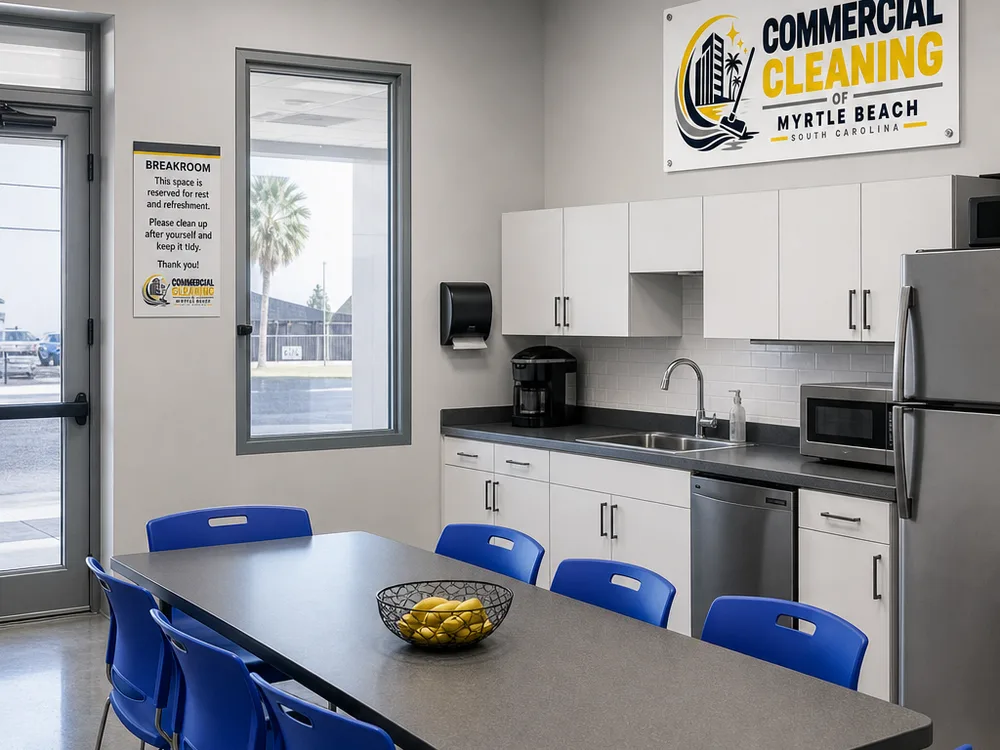
Nobody owns the office kitchen, so it degrades until someone complains. A written frequency is what stops that cycle.
Free assessment · Worked outside your hours · No obligation
Responsibility for the shared kitchen is genuinely undefined, so it degrades until someone finally complains about it.
Three busy days and two quiet ones means a flat daily schedule is wrong on both, wasteful midweek and short on peak days.
Headcount rises and a suite is added, but the cleaning scope was written for the company you were two years ago.
A client waiting in the lobby reads the floors and the glass, and forms a view of the business from them.
Shared handles, switches and equipment move it between teams faster than any sick-day policy responds.
Multi-site and remote-managed offices have no one walking the floor, so a slipping standard goes unreported for months.
A workplace changes shape constantly: people join, teams move, and attendance patterns shift. We build the scope around how your office is actually occupied and revise it as that changes, so the agreement never quietly falls behind the business.
The recurring scope covering kitchens, restrooms and reception.
Read more
For multi-tenant buildings with shared common areas to cover.
Read more
Carpet traffic lanes and hard floors in the areas clients see first.
Read more
Partition glass and exterior windows that change how the space feels.
Read more
Periodic resets for carpets, vents and the areas routine visits skip.
Read more
Move-in and move-out cleans when a suite changes hands.
Read more
Adding people or space triggers a documented revision instead of overloading an old agreement.
Hybrid offices stop paying peak-day frequency for days when barely anyone is in.
Logged visits let a remote or multi-site manager check the standard from anywhere.
Shared spaces are what staff cite when asked about their working environment, and they are cheap to get right.
Documented condition turns a dilapidations conversation into a factual one.
We walk the floor at the end of a working day, when shared spaces show their real condition.
Restrooms and kitchens get the higher frequency, reception gets the visible standard, all in writing.
The same crew learns your access rules and layout, so a desk move needs no re-explaining.
Checks target the shared spaces staff complain about first, not the areas that are quick to do.
Headcount changes and new rooms update the scope the same week rather than becoming an informal request.
An office changes shape faster than most cleaning agreements do. These four commitments are about keeping the scope level with the business.
Adding people or a suite updates the agreement rather than quietly overloading the old one.
A manager covering several sites sees the state of this one without walking it.
Hybrid patterns get a schedule built around your busy days instead of a flat weekly route.
An office fit-out or a move should not leave you tied to a scope for a building you left.
Office pricing is driven by restroom count, kitchen areas and how many separate suites the floor divides into, rather than by desk count or headcount.
Usable area plus the number of separate tenancies, since each one carries its own entrance and restroom set.
Actual attendance rather than headcount on paper, which for a hybrid office are very different numbers.
Remote reporting, multi-site consistency and end-of-lease condition work each add scoped time.
A pattern weighted to your busy days usually costs less than a flat schedule and performs better.
Transparent pricing · No hidden fees · No long-term contract required
Usually not. Most hybrid offices are better served by heavier cleaning on their busy days and a lighter pass on the quiet ones, which is written into the scope with the days named.
The scope is revised the same week you take the space, with the added area priced before it is cleaned. It never quietly gets absorbed into the existing visit at the existing price.
Visit records are logged against the written scope, so you can see what was done and when without being in the building. That is the main reason remote-managed sites choose a documented scope.
Yes, and they are scoped separately so there is no confusion about which areas fall to the building and which fall to your tenancy.
Yes. An end-of-lease clean is quoted against your dilapidations requirements, with condition documented so a deposit discussion has evidence behind it.
Tell us your headcount, your busy days and how many restrooms and kitchens the floor has. That is what the quote is built from.
Prefer to talk? Call (854) 504-2770 or email [email protected].
No obligation, and we will not add you to a mailing list.
Free assessment · Response within one business day · No obligation