
!
Waiting rooms cycling constantly
Chairs, door handles and reception counters turn over every twenty minutes through clinic hours.
Serving Myrtle Beach, South Carolina & surrounding areas
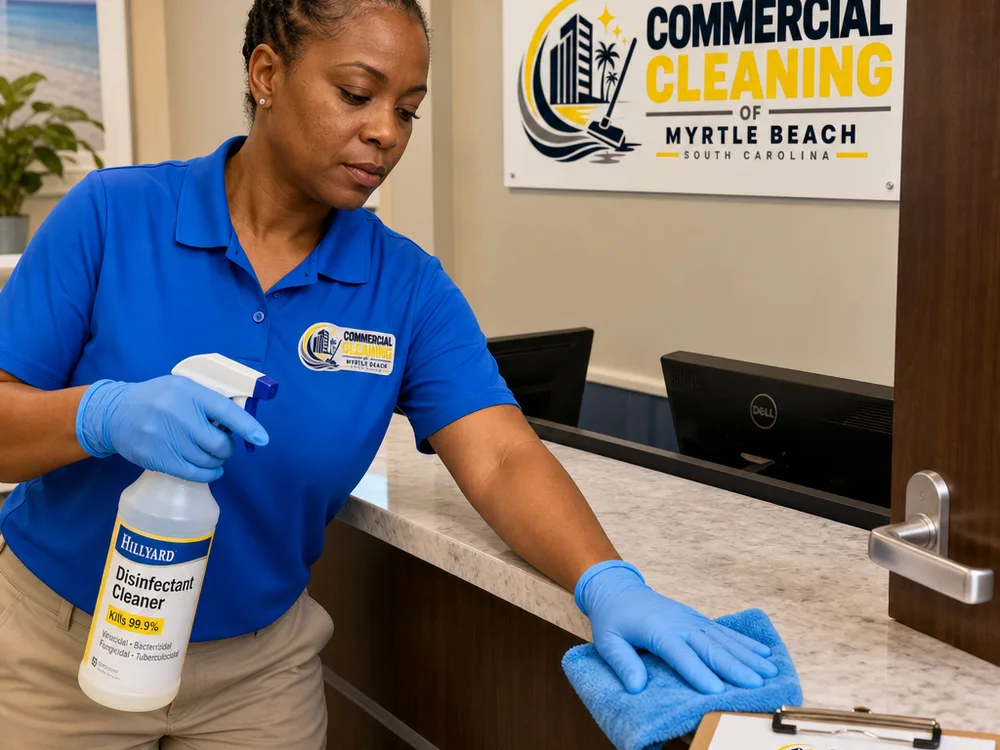
Public areas and clinical rooms need entirely different protocols, and a single cleaning standard applied to both fails at each.
Free assessment · Documented per visit · No obligation
Chairs, door handles and reception counters turn over every twenty minutes through clinic hours.
Clinical rooms and public areas need separate protocols, and treating them alike fails both.
Wiping a surface dry immediately means the product never does what the label claims.
When an inspection or an incident review comes, verbal assurance is not evidence.
It is the one room every patient uses alone, and the one they form conclusions from.
A general cleaner moving between clinical and public areas can carry contamination in either direction.
A medical facility is judged on infection control and on patient confidence, and those are different jobs in the same building. We write separate protocols for clinical and public areas and document each visit, so the standard is evidenced rather than assumed.
The recurring clinical and public-area scope, documented each visit.
Read more
Periodic disinfecting beyond the daily routine, including vents and ledges.
Read more
VCT that must look clinical and hold up to constant traffic.
Read more
Entrance and interior glass patients read as a cleanliness signal.
Read more
Administrative areas still held to a professional standard.
Read more
Fit-outs and refurbishments that must be clinically clean before first use.
Read more
Documented visits turn your cleaning from an assurance into a record.
The areas patients sit in and use alone are the ones that shape their impression.
Written procedures mean a new crew member works to the same standard from day one.
If the standard holds daily, an inspection needs no special preparation.
Color-coded equipment and defined zones stop contamination moving in either direction.
We map clinical and public zones with you and agree what separates them before anything is quoted.
Two written protocols, one per zone, including products, contact times and color-coded equipment.
A consistent crew working to your protocols, because infection control does not survive a rotating roster.
Each visit is logged against the protocol, which is what turns your standard into evidence.
Protocol changes from your practice are written in and dated rather than passed on verbally.
In a clinical setting an assurance is not evidence. Each of these produces something you can show an inspector or a reviewer.
Clinical and public areas are documented separately, including products and contact times.
Your infection control becomes evidence you can produce rather than an assurance you repeat.
Protocol adherence does not survive a rotating roster of unfamiliar staff.
Colour-coded equipment per zone is in the scope, not left to a crew member's memory.
Medical pricing depends on the number of clinical rooms, the protocols you require and how much documentation your practice needs, not on floor area alone.
Clinical room count matters far more than floor area, since each one carries its own protocol.
Patient throughput sets how often waiting areas and restrooms need attention during clinic hours.
Protocol complexity, product specifications and documentation requirements all affect staffing.
An evening clean with a mid-day waiting-area pass costs more than a single daily visit, and usually earns it.
Transparent pricing · No hidden fees · No long-term contract required
We work to the protocols your practice specifies, including products, contact times and zone separation. Those go into the written scope so they survive any staff change on either side.
Yes. Most practices prefer an evening visit after the last appointment, with a lighter mid-day pass on waiting areas and restrooms during busy clinics.
Color-coded equipment and cloths per zone, so nothing used in a clinical room moves to a public area or the reverse. It is written into the scope rather than left to memory.
Yes. Each visit is logged against the written scope, which gives you a dated record of what was cleaned and when.
We handle general and recycling streams and follow your procedures for segregation. Regulated medical waste collection is a licensed service handled by your existing provider.
Tell us how many clinical rooms you run and what protocols you require. We will write clinical and public areas as separate scopes before quoting.
Prefer to talk? Call (854) 504-2770 or email [email protected].
No obligation, and we will not add you to a mailing list.
Free assessment · Response within one business day · No obligation