
✓
Commercial Cleaning
Standards drift when nobody has written down what gets cleaned and how often.
Serving Myrtle Beach, South Carolina & surrounding areas
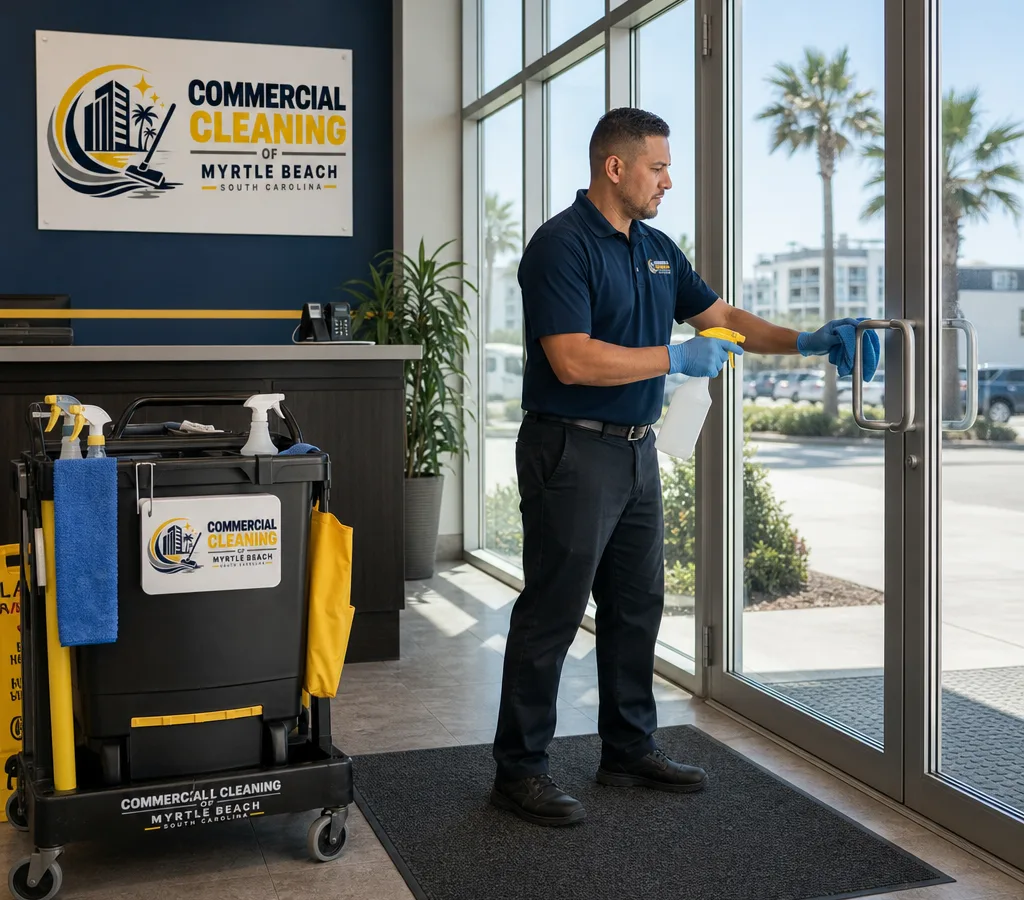
When the restrooms run dry on a Friday and nobody can tell you who cleaned last, the problem is not effort. It is the absence of a written standard.
The usual story is not a crew that does nothing. It is a crew that does something slightly different every week. Nobody wrote down whether the glass doors get done nightly or on Fridays, so the answer changes with whoever shows up.
That gap costs you in ways that show up on a walkthrough: a lobby that looks tired before a client meeting, restrooms out of paper by mid-afternoon, staff quietly buying their own supplies, and a manager spending Monday morning sending photos to a vendor.
We start with a written scope that names every task and its frequency, then hold the same crew and the same checklist to it. When something needs to change, it changes on the document, not by word of mouth.
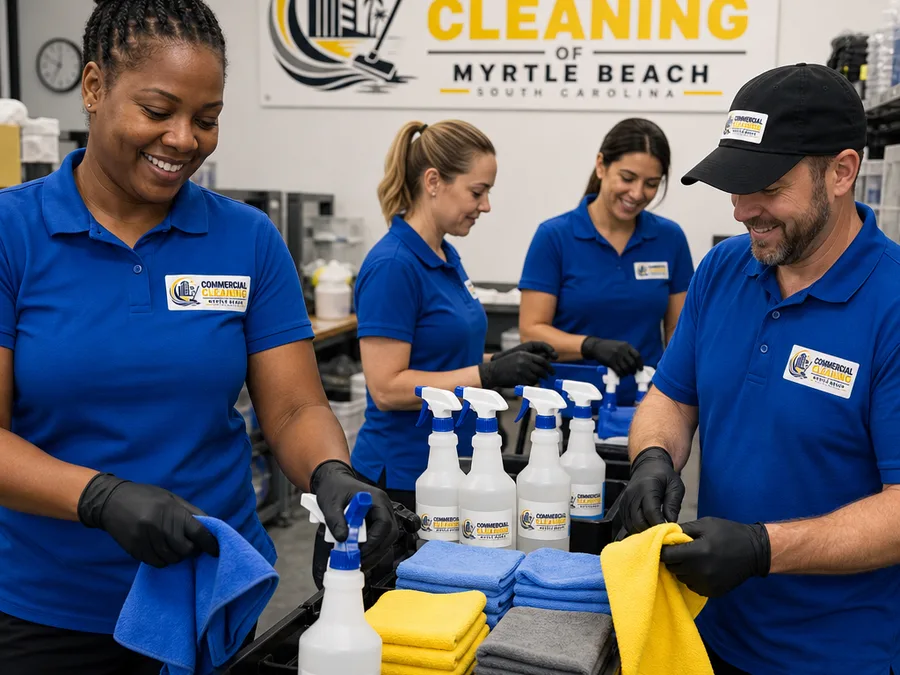
Each of these exists because a specific failure keeps repeating in commercial buildings. The outcomes listed are what changes once it is handled on a schedule.
Standards drift when nobody has written down what gets cleaned and how often.
Recurring service that quietly shrinks to whatever fits the time available.
One method used on every surface, which dulls VCT and grays out carpet.
Buildup in corners and grout that a nightly routine will never catch up on.
Fine drywall dust that keeps resettling for weeks after the trades leave.
Salt haze and hand smudges on the first thing every visitor sees.
Shared kitchens and desks that no single person owns.
Warehouse dust and loading-dock grime that ordinary janitorial skips.
A clinic and a warehouse both need cleaning, but almost nothing about the scope is the same. These are the failures we plan for by building type.
The problem: Grease film creeping up the walls behind the line, and quarry-tile floors that stay tacky however often they are mopped.
What we do: Degreasing on a real schedule and floors treated to lift buildup out of the grout rather than smear it across the surface, worked after close so the line is never interrupted.
The problem: Shared breakrooms nobody owns, and a lobby that forms the client's opinion before anyone says hello.
What we do: Kitchens reset daily rather than wiped, touchpoints disinfected on a fixed rotation, and entry glass on a named frequency so the first impression holds all week.
The problem: Waiting-room chairs and door handles turning over every twenty minutes, with exam rooms held to a completely different standard.
What we do: Separate written protocols for clinical and public areas, disinfectant dwell times actually observed, and a per-visit record you can produce during an inspection.
The problem: Sand and salt walked in from the lot all day, and fingerprints at child height on every pane of glass.
What we do: Entry matting cleaned rather than just vacuumed, glass on a set rotation, and common areas worked outside trading hours so nothing is roped off while customers are in.
The problem: One illness moving through the whole building inside a week, with restrooms taking the heaviest load of any room.
What we do: Touchpoint disinfecting on a fixed rotation and restrooms checked more than once a day through term, with the frequency written down rather than left to judgment.
The problem: Teller counters and ATM vestibules touched by hundreds of hands a day, and cleaning crews needing access to secure areas.
What we do: High-touch surfaces disinfected to a named schedule, and crews who work to your access and supervision rules with the same people each visit rather than a rotating roster.
The problem: Showroom glass marked within an hour of opening, and service-bay grime tracked straight onto the sales floor.
What we do: Showroom glass and floors kept to a display standard, with the boundary between service area and showroom treated as its own job instead of an afterthought.
The problem: Hair and product residue that ordinary vacuuming misses, and treatment rooms where clients notice every detail.
What we do: Detailed floor and station work between services, plus restroom and treatment-room standards set high enough for a space clients are paying to relax in.
The problem: Sweat and bacteria on shared equipment, and locker rooms where humidity turns a missed corner into an odor problem fast.
What we do: Equipment and mats disinfected on a frequency matched to your traffic, and locker rooms and showers worked to stop mildew before members start mentioning it.
We cover the Grand Strand from Conway to Little River. Visits are scheduled around your opening hours, and a schedule change gets a same-day answer rather than a callback next week.
Office corridors and clinics inland, where weekly restroom reliability matters more than street frontage.
Growing professional suites and medical offices that need a routine holding steady as they expand.
Older commercial buildings where floors and corners hold buildup a standard mop pass will not lift.
Storefronts and hospitality-adjacent businesses carrying heavy seasonal swings.
Waterfront-adjacent premises where salt film on glass and entries returns faster than inland.
Beach-access traffic that tracks sand straight into entries and lobbies through the season.
Five steps, in order. The point of the first two is that nothing after them depends on anyone remembering what was agreed.
We walk the building with you and note what is actually going wrong, not just its square footage.
You get a written scope naming every task and its frequency, so nothing depends on memory.
The same crew works your building, so the scope does not have to be re-explained each visit.
A supervisor walks the building against the scope and logs what was found, so a problem surfaces before you notice it.
One contact for changes, and the scope document is updated when your needs shift.
These are business outcomes rather than cleaning tasks, because they are what a facility manager is judged on.
When restrooms and entries are handled to a written frequency, tenants and staff stop reporting the same issue.
Entry glass and floors on a set rotation means a client visit never needs advance warning.
Touchpoint disinfecting on a fixed schedule cuts the shared surfaces that move illness through a building.
Scope and frequency are agreed up front, so the invoice does not move without a conversation first.
We agree who restocks what, so nobody discovers an empty dispenser on a Monday morning.
Quality checks are documented against the scope, so a review is reading a record rather than trading opinions.
Every point below is a direct answer to something a Myrtle Beach business owner has described going wrong with a previous cleaning company.
Every task and frequency is on paper, so there is no argument later about what was included.
Consistency is what makes a standard hold. High turnover is why most cleaning quality slides.
Supervisor checks are recorded against the scope, not asserted after the fact.
Schedule changes and questions go to a person who can act on them, not a general inbox.
Anything outside the scope is quoted before it happens, never added to an invoice afterwards.
We are based on Dividend Loop, so a walkthrough or a fix does not wait for a regional schedule.
There is no useful flat rate, because two buildings of the same size can differ by a factor of two once restrooms, floor types and access hours are accounted for. Pricing is built from your actual facility after a walkthrough.
Total area matters less than how it breaks up: restroom count, separate suites and stairwells drive labor.
Nightly, three times a week or weekly changes both the per-visit workload and the monthly total.
A storefront in season and a back-office suite need different frequencies to hold the same standard.
Floor restoration, interior glass, post-construction dust or clinical disinfecting are scoped separately.
Transparent pricing · No hidden fees · No long-term contract required
We would rather point at the things you can check than list adjectives. Each of these is verifiable from your own records after the first month.
You hold the same written scope we work from, so any review starts from one shared document.
Quality checks are logged per visit, which means a pattern shows up as a pattern, not a disagreement.
Requests go to someone who knows your building, reachable on the number on this page.
No long-term contract is required, so the first month stands on the work rather than on paperwork.
Client references are available on request for comparable Grand Strand facilities.
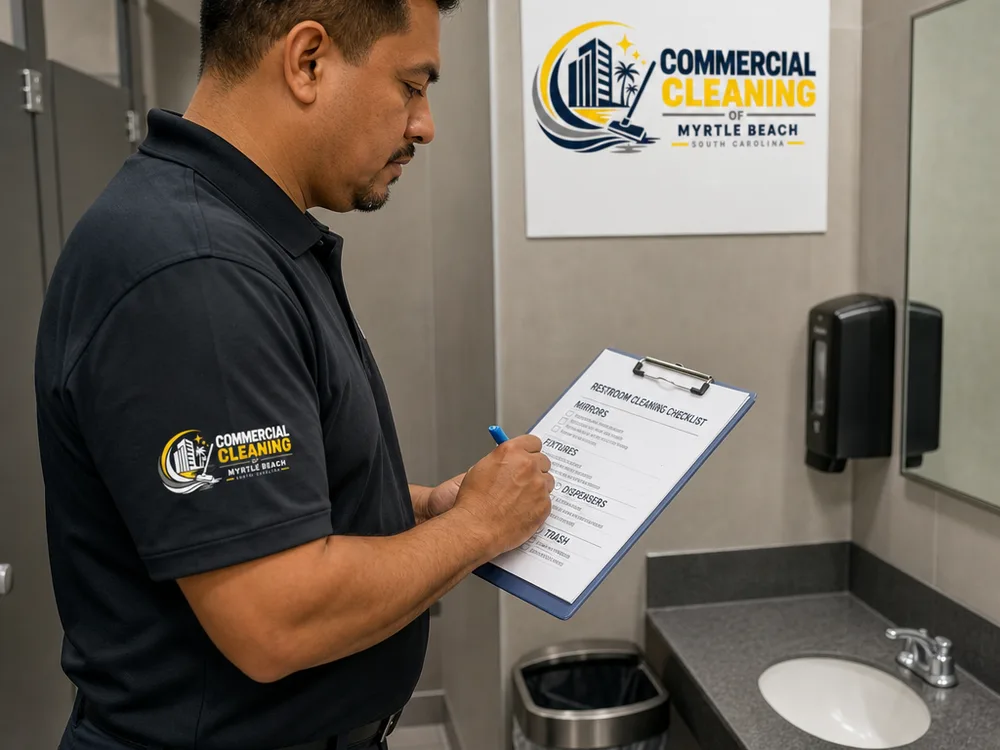
We are a commercial cleaning company based at 1471 Dividend Loop in Myrtle Beach, working with property managers, office administrators and business owners across the Grand Strand.
The company exists because of a specific, boring failure: buildings get cleaned without anyone agreeing in writing what cleaning means. We fix that first, then do the work to the document.
What we hold ourselves to is narrow on purpose. A written scope before the first visit, the same crew in your building, and quality checks recorded where you can read them.
1471 Dividend Loop, Unit 5, Myrtle Beach SC 29577 · (854) 504-2770
Offices and professional suites, medical and dental practices, retail storefronts, hospitality-adjacent businesses, restaurants, multi-tenant common areas, warehouses and childcare facilities. The walkthrough confirms restroom count, floor types and any customer-facing priorities before anything is quoted.
Yes. Most buildings we work in have a cleaning window that only exists when they are empty, so visits are scheduled around opening hours, deliveries and quiet periods rather than a fixed route time.
You raise it with a named contact and it is checked against the written scope. If it was in the scope, we correct it and the quality check records why it was missed. If it was not, we quote it before adding it.
Both. A building with real buildup usually needs a reset clean before a recurring schedule can hold a standard, so the deep clean comes first and the routine maintains it.
An on-site walkthrough, then a written scope. Pricing follows square footage, restroom count, floor types, access hours and current condition, which is why a number over the phone would be a guess.
Tell us what kind of facility you manage and what keeps going wrong. We will walk the building, write the scope, and set a routine your team can rely on.
Prefer to talk? Call (854) 504-2770 or email [email protected].
No obligation, and we will not add you to a mailing list.
Free assessment · Response within one business day · No obligation